The Nairobi Expressway
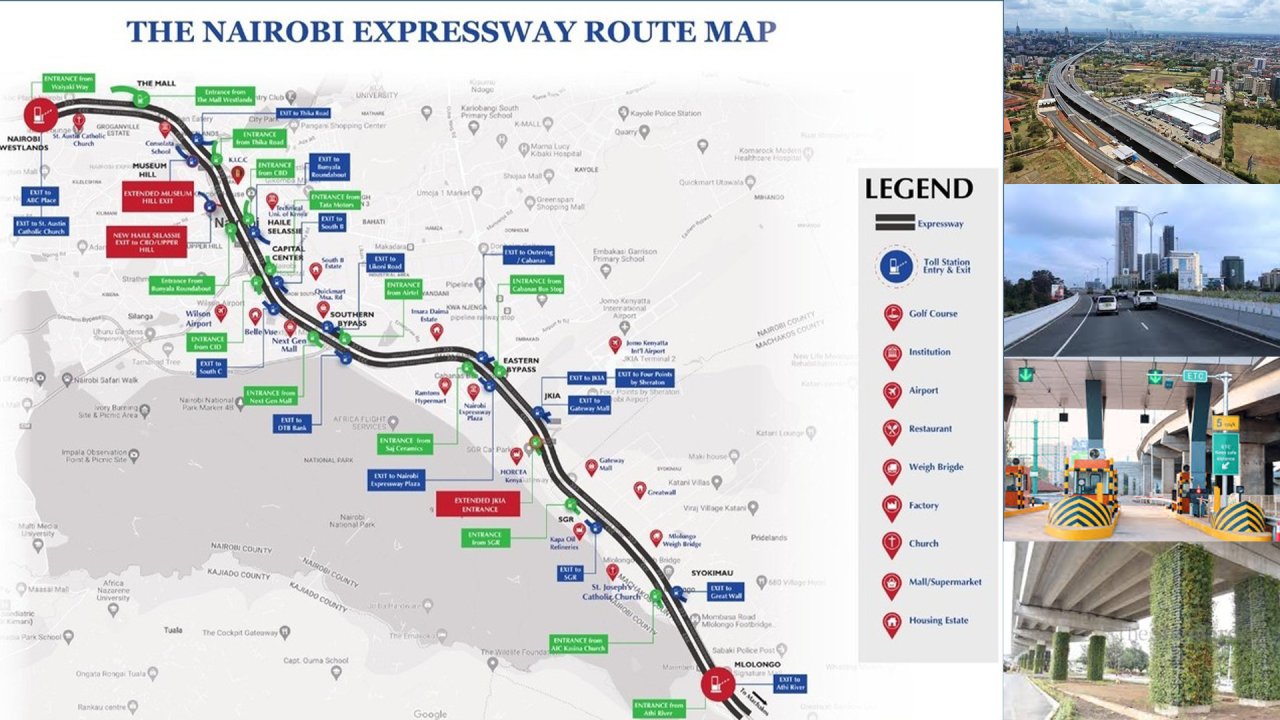
The Nairobi Expressway was designed to alleviate traffic congestion in Nairobi by providing a faster route from Jomo Kenyatta International Airport (JKIA) to James Gichuru junction along Waiyaki Way in Westlands in 15 to 20 mins aside from the hour. Its still the first and only toll road project in Kenya.
The 27.1 kilometer toll road (18.2 km on the ground and 8.9 km elevated) was constructed under a public-private partnership between the Government of Kenya and the China Road and Bridge Corporation (CRBC) on a Build Operate Transfer (BOT) Model.
It is a four lane road with 2 traffic lanes in each direction and 10 interchanges (Mlolongo, SGR terminus, Eastern and Southern bypasses, Capital Centre, Haille Selassie, Museum Hill, The Mall – Westlands and James Gichuru Road junction).
The common tale is that the idea was proposed from a dinner table in a minister`s trip to Beijing in 2019 but earlier reports indicate that its conception dates back to 1997 and first approved by the Cabinet in 2009. At the time, the project was first suggested to be funded by the World Bank. They had estimated that Nairobi’s traffic jams will come to cost the country about Sh50 million daily in lost man hours.
Development History:
2011
World Bank, as the main financier at the time, declined to fund the project until Strabag, the then contractor, complied with its social and environmental safeguards, and land acquisition and Kenyan legal provisions.
2016
Designs were proposed and the highway was to stretch from JKIA to Rironi which is 45.2km and world bank was to support the construction and supervision of it. It was also to include bus lanes.
World Bank finally committed to provide $380 million to the project, with construction anticipated to start in December but still could not work out due to environmental concerns.
2018
In September, the Government of Kenya invited China Road and Bridge Corporation (CRBC) to build this toll road on a public-private partnership (PPP) model during the 2018 FOCAC Summit in Beijing.
CRBC was to use its own money to construct the road expansion, interchanges, and toll stations. They are then to collect the toll fees until their investment is recovered, then the road reverts to government.
In November ,CRBC undertook a project feasibility study. The cost of the toll highway was quoted at $510 million at the time and was to collect the tolls ranging between $1 and $15 (dollar based) depending on vehicle size and distance covered.
Statistics around it were that up to 60,000 vehicles use the JKIA-Westland route daily and about 25,000 motorists are expected to use the tolled express highway when completed.
2011
World Bank, as the main financier at the time, declined to fund the project until Strabag, the then contractor, complied with its social and environmental safeguards, and land acquisition and Kenyan legal provisions.
2016
Designs were proposed and the highway was to stretch from JKIA to Rironi which is 45.2km and world bank was to support the construction and supervision of it. It was also to include bus lanes.
World Bank finally committed to provide $380 million to the project, with construction anticipated to start in December but still could not work out due to environmental concerns.
2018
In September, the Government of Kenya invited China Road and Bridge Corporation (CRBC) to build this toll road on a public-private partnership (PPP) model during the 2018 FOCAC Summit in Beijing.
CRBC was to use its own money to construct the road expansion, interchanges, and toll stations. They are then to collect the toll fees until their investment is recovered, then the road reverts to government.
In November ,CRBC undertook a project feasibility study. The cost of the toll highway was quoted at $510 million at the time and was to collect the tolls ranging between $1 and $15 (dollar based) depending on vehicle size and distance covered.
Statistics around it were that up to 60,000 vehicles use the JKIA-Westland route daily and about 25,000 motorists are expected to use the tolled express highway when completed.
Concerns:
- Initial budget was at ksh 44 billion when proposed and ended at ksh 88 billion during completion. What happened midway is not revealed to the public. It is even rumored that what we are to pay back is about ksh 100 billion.
- Exits were not well thought through and the manual cash system queue that has ended up reintroducing traffic especially at the Museum area. The new Haille sellasse exit was also ignored in the initial scope despite of being in the design.
- Top Govt. official at the time was alleged to have pocketed over ksh 1 billion in kickbacks.
- Reports circulating to date is that they are operating at a loss as at the books in June 2024 which is unclear where it is coming from. A whole ksh 1.2 billion in losses!
My conclusions:
- Many consider this project a success perhaps because it was actually completed, something not common with public projects. Some of us still don`t hold the same conclusion.
- It was not really transparent as may be perceived. In my view, its too over priced.
- The need seems to be there but the end goal was to serve people from the airport and not a majority of the public hence no social impact. Maybe no one paid attention here.
- The sole authority provided to CRBC to adjust toll fees due to dollar fluctuations is also something not sustainable. 100% of that cost is pushed to the user without Govt. intervention.
The Expressway is iconic and a game changer for the seamless connectivity and decongestion of roads.
For more information, reach out to us via info@rickfes.co.ke
At Rickfes Construction Ltd, we are keen to conduct thorough research and critique on large infrastructure projects in the country as part of efforts to contribute to a better Kenya!