Affordable Housing – Singapore Model
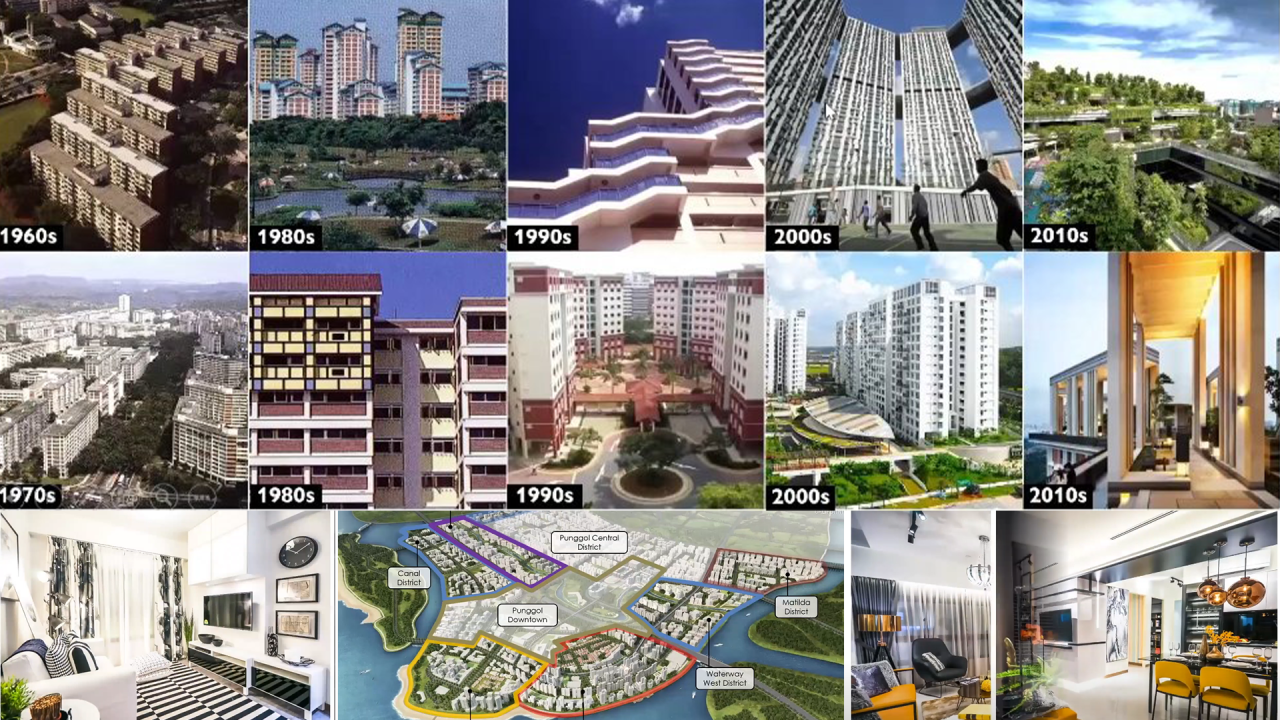
60 years ago, Singapore was a nation of slum and squatters and this prompted the Govt. to come up with Housing and Development Board (HDB) in 1960 to provide Affordable Public Housing. This was a progressive effort over the decades as it has now built over 1.1 million flats with continuous improvements.
This aim was a success due to the following reasons:
– Strong Commitment from Govt.
– Focus on Inclusive Home Ownership.
– Financing through use of Central Provident Fund (CPF).
– Continuous renewals & rejuvenation as well as responsive housing policies.
The frame work used was based of 4 drives:
1. Prioritize Home Ownership – equitable and stable society.
So why home ownership?
– Promote rootedness and belonging.
– Provide an asset and store of value.
– Encourage better maintenance.
It was done through a policy that caters needs based on the lifecycle.
– Young couples had assistance to buy first home with housing subsidy and concessionary housing loan.
– Families with children had assistance to buy bigger flats with subsidy and housing loan.
– The elderly had home equity with elderly friendly homes.
What of the legislature?
– HDB built low cost basic housing fast mainly rentals.
– In 1964 they introduced Home Ownership for the People Scheme which targeted lower to middle income households and offered low cost mortgage financing.
– In 1967 the land acquisition act came in place which allowed the state to easily plan redevelopment and this was complemented by resettlement policies where there was increased pay-outs over time until the market cap was reached.
– In 1968 CPF came in and approved the housing scheme. As of 2018,out of the total no of flats were 94% are for home ownership (as a cornerstone of public housing) while 6% are rental (for low income households not ready to own home).
So basically for one rental unit there are 16 owner units.
2. Ensure Affordability – safety net for retirement adequacy.
On affordability the CPF is used to finance housing under the Singapore`s social security savings plan.
So the CPF savings are from 2 parties ; 20& of employees and 17% on employees in wages which give a total of 37%.
– 23% goes to an ordinary account for buying a home paying CPF insurance,investment and education.
– 8% goes to a medisave account for hospitilisation expenses and approved medical insurance.
– 6% goes to a special account for old age and investment in retirement related financial product.
Flats are priced based on a monthly mortgage equivalent of less than 25% monthly income (international benchmark at 30%-35%) and you are able to pay with CPF savings with minimal or no cash top up.
Public rental flat sizes
– 2 BR = 36 -45 sqm
– 3 BR = 65 sqm
– 4 BR = 90 sqm
– 5 BR = 110 sqm
– 3rd Gen Flat = 115 sqm
3. Policies Meet Needs of Different Segments – strengthen social cohesion and family.
Different segments were created majorly is on the basis of age group and working class.
Provision for singles (35+):
– 2 room news flats/resale flats.
– Grants at half of those for a family.
– Top up the grants once you are married.
Provision for the elderly :
– Priority allocation of new flats to married child and parents to live together or nearby.
– Provide grand to buy resale flat.
– Build 3gen flats.
– Rent out rooms/whole flat.
– Lease buyback scheme.
– Carry out upgrading works.
– Adopt a universal design and barrier free accessibility.
– Provide optional fittings in 2 room flexi flats.
Provision for low income households :
– 1 or 2 room flats at heavily subsidized rents.
– Support families with young children in public rental flats to own a flat.
– Priority allocation of new flat, grant to buy new or resale flat.
3. Policies Meet Needs of Different Segments – strengthen social cohesion and family.
Different segments were created majorly is on the basis of age group and working class.
Provision for singles (35+):
– 2 room news flats/resale flats.
– Grants at half of those for a family.
– Top up the grants once you are married.
Provision for the elderly :
– Priority allocation of new flats to married child and parents to live together or nearby.
– Provide grand to buy resale flat.
– Build 3gen flats.
– Rent out rooms/whole flat.
– Lease buyback scheme.
– Carry out upgrading works.
– Adopt a universal design and barrier free accessibility.
– Provide optional fittings in 2 room flexi flats.
Provision for low income households :
– 1 or 2 room flats at heavily subsidized rents.
– Support families with young children in public rental flats to own a flat.
– Priority allocation of new flat, grant to buy new or resale flat.
Conclusion:
The Government provides ground support in the following ways:
– Provides upto SGD 20,000 per project as funding.
– Help applicants improve their ides & obtain technical approvals. – Regular call for ideas through the lively places challenge.
According do a survey done in 2018 to determine the satisfaction levels:
– 95% in neighbourhood as contributed by convenient location,friendly neighbours and quiet environment.
– 98% in estate facilities as contributed by location,workability to transport and spaciousness of the housing estate.
– 99% have a sense of belonging.
– 47.6% participate in community activities.
– Trust and reciprocity among neighbours at 60%.
I do not think it is a question of; should I build sustainable or should I build affordable. You can do both at the same time.
For more information, reach out to us via info@rickfes.co.ke
At Rickfes Construction Ltd., we begin every project with clarity and confidence through a detailed Feasibility Study. Our team evaluates the technical, financial, legal, and environmental aspects of your proposed project to determine its viability before any investment is made.