
Can a Rammed Earth Project be Approved in Kenya
The question of whether a rammed earth project can be approved in Kenya comes up frequently among developers, aspiring homeowners, professionals and investors. Some want assurance that the building is safe. Others need approval from the relevant authorities or want to use the property as security for a bank loan. In most cases, the underlying concern is the same: if rammed earth is not a conventional building material in Kenya, what standards can be used to justify its use?
Well, a rammed earth project can be pursued for approval in Kenya, but its acceptance depends on demonstrating that the proposed building meets the applicable planning, structural safety and building requirements. The absence of a dedicated Kenyan standard for rammed earth does not automatically make the construction method unacceptable.
Kenya has no dedicated standard specifically governing rammed earth construction in the way that conventional materials and systems are addressed. General guidance exists, including KEBS reference KS ARS 1305:2016, which is relevant to the discussion of earth construction. This leaves a practical challenge for professionals working with rammed earth. The question should therefore not stop at whether a standard exists. It should also ask how the proposed construction can be tested, designed and verified to demonstrate that it is fit for its intended purpose.
In practice, a rammed earth project should begin with an investigation of the available soil and its suitability for construction. Depending on the soil type, proposed stabilisation method and project requirements, relevant tests may include:
- Moisture content – establishing the water content of the soil during testing and compaction.
- Particle size distribution – determining the proportions of gravel, sand, silt and clay.
- Shrinkage and plasticity – assessing the potential for dimensional changes and cracking.
- Density and Proctor compaction – establishing suitable compaction characteristics and target dry density.
- pH – assessing soil chemistry where it is relevant to the selected binder and stabilisation method.
- Compressive strength – determining the load-bearing capacity of representative specimens or wall samples.
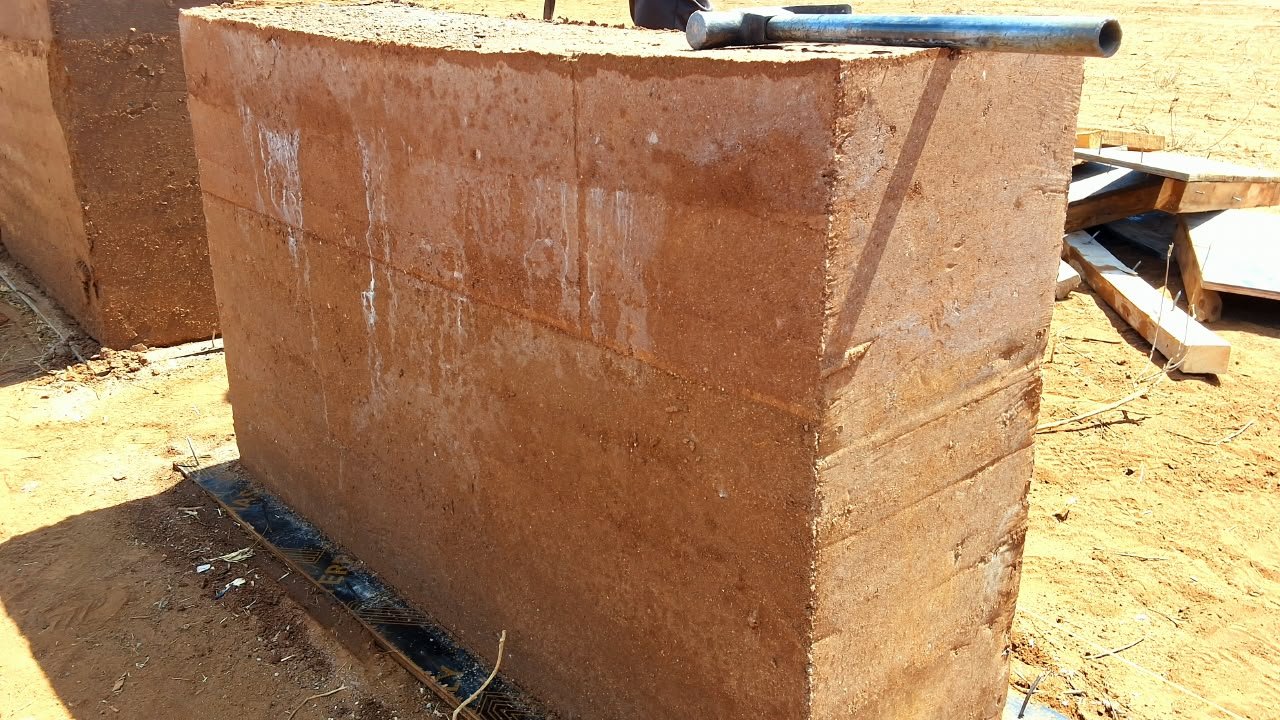
One practical approach is to construct mock-up walls using different soil mixes, binder proportions and compaction procedures. These samples can then be tested to identify the combination that performs best against predetermined project requirements. The objective is to establish the performance of the actual material and construction system rather than assume that all earth walls behave alike.
The selected mix, together with the approved construction procedure, becomes the project-specific benchmark for production. Subsequent construction must consistently meet that benchmark through quality control. This approach does not mean that the builder can invent a standard and disregard existing regulations. The performance criteria and testing methods must be technically defensible and approved by qualified professionals.
There is a wider issue worth addressing. Inherited construction practices can influence what we consider acceptable, sometimes making conventional materials the default simply because they have established standards. The absence of a dedicated standard should prompt a technical process for evaluating the material, not an automatic rejection of the construction method.
Rammed earth has its own characteristics. The appropriate response is to understand those characteristics, test them, establish acceptable performance criteria, design accordingly and control execution on site. This must happen within the general guidelines.
In conclusion, the objective should be to make the construction method demonstrably safe and fit for purpose, rather than force it to behave like a different material. Kenya does not need to approve rammed earth merely because it is traditional, affordable or environmentally attractive. It needs a defensible basis for deciding when and how it can be used safely. And this evolves by building and experimenting more with the material.
The question should therefore not stop at whether a standard exists. It should also ask how the proposed construction can be tested, designed and verified to demonstrate that it is fit for its intended purpose.
For more information, reach out to us via info@rickfes.co.ke
At Rickfes Construction Ltd., we help you assess and implement construction methods such as rammed earth based on technical suitability, material performance, cost and regulatory requirements. We support the process from soil assessment and mix development to testing, construction methodology and quality control, helping clients establish a sound technical basis for their projects.