

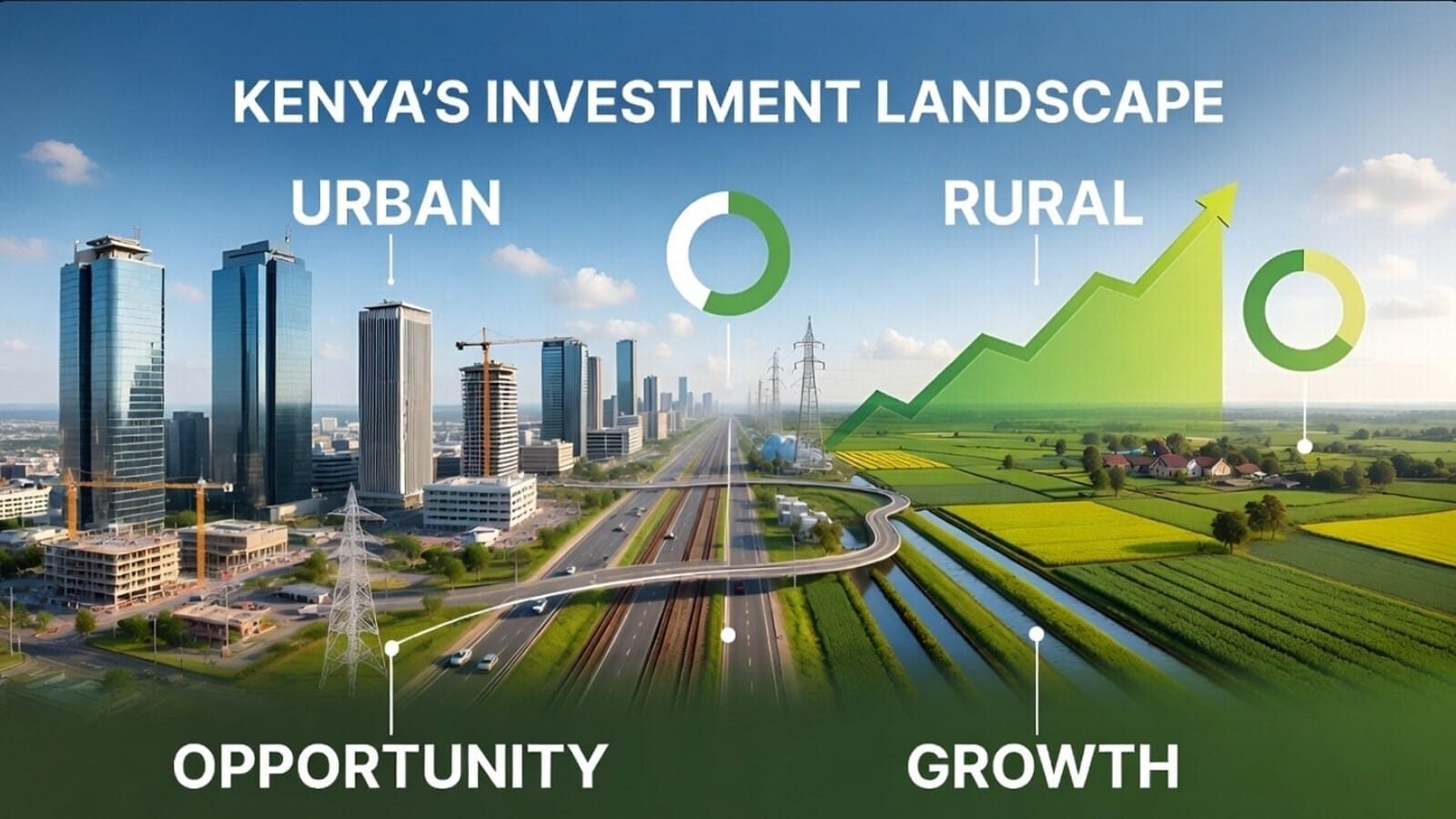
Top 8 Investment Opportunities In Kenya (2026)
Before investing, conducting your own due diligence is critical, regardless of what you may have heard; even from trusted sources. Investors do not only lose money in fake projects, but also in ventures that are poorly structured, poorly understood and poorly executed.
Across emerging and frontier markets such as Kenya, several sectors consistently demonstrate strong demand, scalability and long-term relevance. These sectors are not low risk (as no worthwhile investment ever is), but they offer a higher probability of success when implemented correctly.
Highly successful investments are not those that promise overnight returns, but those that:
Solve a real, persistent problem
Have clear demand drivers
Align with policy, demographics, or macroeconomic trends. This is especially important when setting up in Special Economic Zones (SEZs), where government approval depends on capital value and job creation potential and in return you get favorable tax and operational incentives,
We have mapped out the following sectors (not in order of priority) for your consideration:
1. Energy – Power and Clean Cooking Solutions
Kenya is still a developing country experiencing rapid population growth, industrial expansion, grid pressure, and rising power costs. This creates opportunities for solar power generation through utility-scale solar farms that supply small industrial users, business parks, and institutions.
Rising fuel costs, health concerns and the global sustainability agenda have transformed clean cooking solutions such as biogas from social projects into commercially viable businesses. Opportunities exist in sustainable production and efficient distribution models.
2. Export-Oriented Manufacturing
Global trade dynamics have become increasingly complex, including tariff wars between major economies. This presents an opportunity.
When high tariffs exist between exporting and importing countries, investors can manufacture in alternative jurisdictions such as Kenya and export under favorable trade agreements, thereby reducing tariff exposure.
Successful setup requires creating sustainable jobs and focusing on manufacture of industrial components, electronics, and consumer goods.
3. Cold Storage
Agriculture is the backbone of Kenya’s economy. Exports such as avocados, vegetables, fish, meat and milk are in high demand. Preservation and extended shelf life are critical, especially since much of this produce is seasonal.
Cold storage facilities can operate as standalone commercial outlets, primarily serving farmers and exporters.
4. Light Industrial and Assembly Parks
Kenya’s trade capacity and market dynamics are not yet suited for heavy industrial developments, but light industrial parks perform well.
Beyond warehousing, these parks can support assembly of automotive parts, medical equipment, electronics and furniture for local and regional markets. Investors operating within Special Economic Zones benefit better through from fiscal and regulatory incentives.
5. Agro-Industrial Developments
Agriculture is gradually shifting from open-field production to controlled systems.
In arid and semi-arid regions, there is strong potential for hydroponic farms, greenhouse clusters, pack houses and processing plants.
6. Tourism and Hospitality
Tourists visit Kenya for wildlife, historical sites, and cultural experiences. Today’s traveler does not want to encounter accommodation that looks the same as everywhere else.
High-demand concepts include eco-lodges, camping sites, scenic cabins, modular resorts, and retreat centers. Location and target market profiling are critical.
7. Small-Scale Retail Shopping Centers
Traditional malls and mini-malls are capital intensive. Modular and boxed retail centers are more agile and cost-efficient.
These serve fast food, entertainment and social spaces, especially for youthful populations. Construction is faster using modular units, which can be relocated if market conditions change.
8. Waste Recycling and Circular Economy
Every developing economy requires affordable products and better waste management. Recycling, reducing, and reusing waste such as agricultural, construction, and plastic waste; offers strong commercial and environmental value.
Investors can adopt direct conversion technologies or create full circular systems. The key question is: who needs the product, and what impact will it generate?
Conclusion
Failure in any of these sectors is usually linked to skipping feasibility studies, assuming demand, underestimating costs, and ignoring operational realities.
If you study the market thoroughly, tailor your model to fit local conditions, roll out professionally, and secure the required approvals, success becomes highly achievable.
Building for the long term and executing deliberately requires sound structure and clear strategy.
NB: Other common opportunities such as Real Estate, Mining and Oil and Gas are still viable though take much longer to break even.
Investors do not only lose money in fake projects, but also in ventures that are poorly structured, poorly understood and poorly executed.
For more information, reach out to us via info@rickfes.co.ke
At Rickfes Construction Ltd, we support local and international investors through feasibility studies, development structuring, regulatory liaison and on-the-ground project execution. Whether in energy, manufacturing, agro-industrial, or tourism developments, we act as your development partner to ensure your investment in Kenya is professionally planned, compliant, and built for long-term performance.