

Best Locations For a Good ROI in Kenya
All over the world today, location is at the centre of every development decision. For organic success, you must get it right. It is not hype or perception that should guide investment decisions, but the actual potential of the area.
A good location is defined by fundamentals that support both livability and commercial viability. These include:
- Well-built and maintained infrastructure such as roads, sewer lines, water supply and reliable power connections.
- Proximity to workplaces, which increases convenience and supports demand for residential and mixed-use developments.
- Good security, including areas free from environmental or wildlife-related risks.
- A friendly and stable neighbourhood, where residents and businesses can comfortably settle.
- Good site conditions, such as stable ground that is not overly sloped, muddy or flood-prone.
- Proximity to scenic viewpoints, especially for off-grid homes, resorts and retreat-style developments.
- Access to reliable social amenities such as shopping centres, schools, hospitals and places of worship.
These fundamentals create a strong base but what makes a location truly profitable depends on best fit purpose and typology.
This is where many developers get it wrong. A location may perform exceptionally well for one type of project and fail completely for another. A site may work well for a hotel but underperform for a residential apartment.
Likewise, an area may support residential development, but the right typology may be 1-bedroom units instead of 2-bedroom apartments, or townhouses instead of apartments altogether.
This is why developers must avoid forcing projects into locations simply because similar developments exist nearby. Profitability comes from aligning location with market demand and the right product mix.
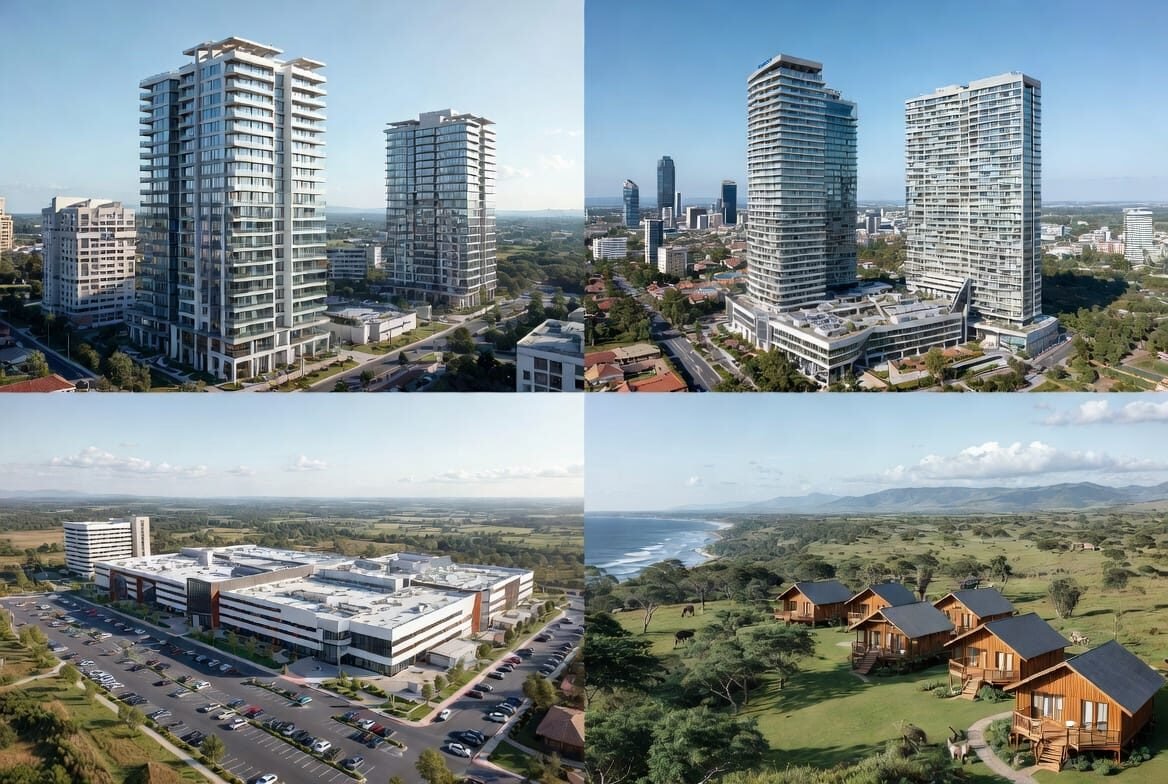
For standard high-rise residential apartments, the best returns are generally found within the metropolitan zones of Kenya’s five cities, where population density, infrastructure, and rental demand are strongest. Exact unit mix and positioning, however, should still be validated through a feasibility study.
For luxury apartments, city centres and premium urban neighbourhoods tend to perform better because they attract a higher-income market. Here, rental and selling prices must be significantly higher to justify the elevated land acquisition costs.
For commercial developments, city centres remain attractive depending on the economic activity involved; whether wholesale, retail, office spaces, restaurants, or co-working hubs. However, shopping malls and destination retail centres are often better positioned outside city centres in strategic locations that are easily accessible along commuter routes as people head home.
For resort-style accommodation, the best locations are those close to attraction sites. What matters most is the experience and surrounding appeal, provided the area is free from major natural risks such as floods, storms, landslides, or erosion. Prime resort destinations include:
- The Coastline – Areas such as Mombasa, Malindi, Kilifi, Watamu, and Diani offer strong tourism appeal, with Mombasa and Kilifi also benefiting from historical attractions.
- Game Parks and Reserves – Key destinations include Voi, Mtito Andei, Namanga, Narok, Naivasha, Nanyuki, Nakuru, and Lodwar, where wildlife tourism and scenic landscapes support hospitality investments.
In conclusion, the best location for a good ROI in Kenya depends on matching land potential, project purpose and property typology. When those three align, profitability becomes much easier to achieve. We help developers identify the right locations, determine the best property typologies and structure projects for long-term profitability.
A location may perform exceptionally well for one type of project and fail completely for another. A site may work well for a hotel but underperform for a residential apartment.
For more information, reach out to us via info@rickfes.co.ke
At Rickfes Construction Ltd, we conduct detailed market studies and Comparative Market Analyses to guide project design, unit mix and pricing strategies. Our role is to ensure that every development decision is backed by data, aligned with demand and positioned for long-term performance.