

Ensuring Your Contractor in Kenya Delivers as Expected
The design stage is complete, the budget is ready, procurement done, and the contractor selected. Is the hardest part over? No. Now the real work begins.
Ensuring a contractor delivers as expected starts with how they were selected. The chosen contractor should come from a competitive tender process guided by the professional team. Preselection only works best when you have previously worked with the contractor, not based on referrals alone.
At the early stages, everything may seem smooth, but performance can change midway and some contractors may have been masking underlying weaknesses from the start.
Getting a top contractor through tendering is only the first step. The next and more critical step is continuous monitoring.
Many contractors request advance payments for mobilization. At this point, the key question is: how will that money be utilized. There have been cases where contractors disappear after receiving funds or divert them to non-project use, regardless of insuring them or not. This points to financial indiscipline, something not always visible during the tender stage.
One of the first safeguards is to confirm whether the contractor has a competent internal team; particularly a quantity surveyor, construction manager and project manager. This ensures accountability and proper financial and operational control within their organization.
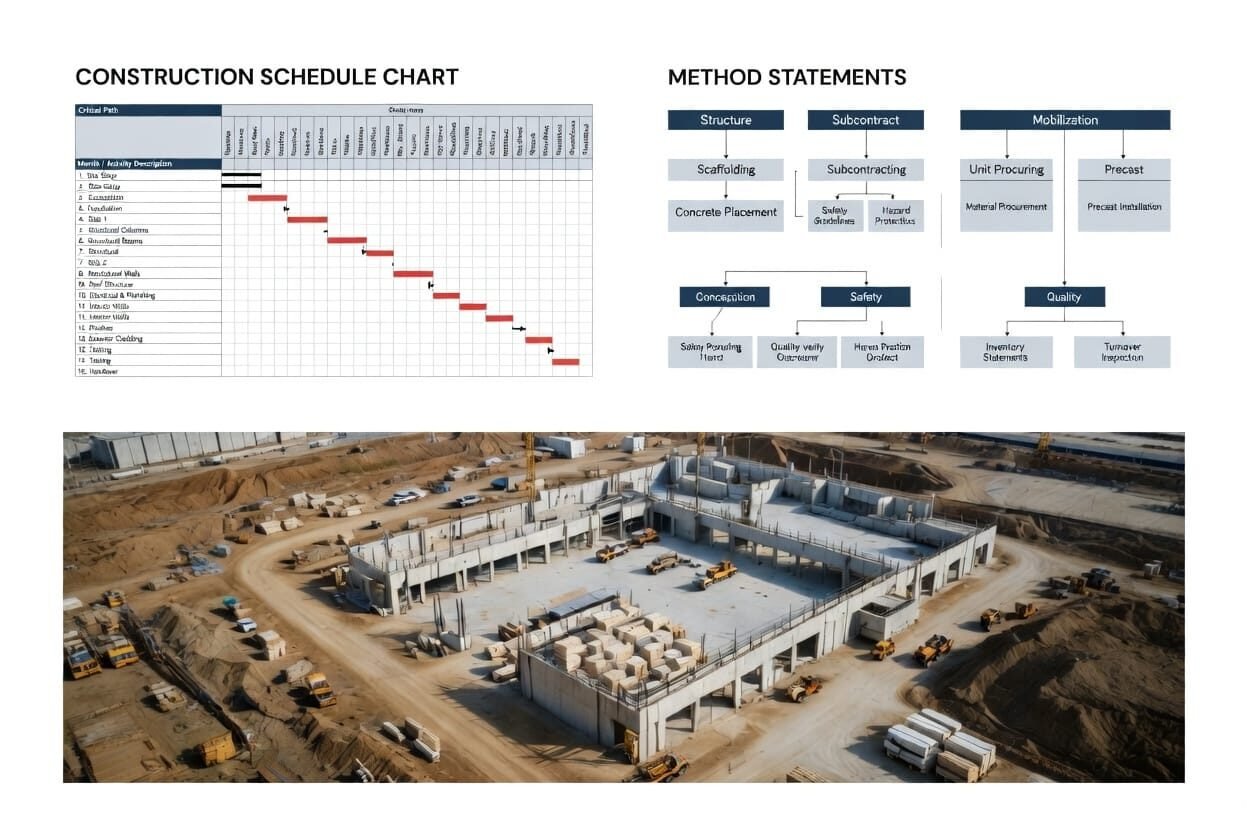
Before breaking ground, the contractor must submit two critical documents: a works programme and a method statement.
The works programme outlines how the project will be executed, including sequencing of activities, timelines and resource allocation. The method statement explains how each task will be carried out and the reasoning behind the chosen approach.
These documents confirm whether the contractor fully understands the project. Any deviation without proper justification should be addressed immediately before work proceeds further.
Additionally, the contractor’s role is execution. Provided financing and approvals are issued on time, there is no justification for failing to meet agreed timelines, cost and quality standards. Risk must therefore be minimized from the contractor’s side.
For instance, the contracting entity should ideally have at least two directors with access to company bank accounts to ensure continuity of payments to workers and suppliers. Relying on a single individual creates a risk of stalling the entire project.
Pacing of work is another critical factor. Some contractors rush execution to show progress but bypass approvals, resulting in poor workmanship. These defects are later presented during the defects liability period, ultimately disadvantaging the client.
It is also important to move away from the assumption that withholding payments guarantees control. Contractors often factor such delays into their pricing and may still walk away, leaving behind defects whose repair cost exceeds the retained amount.
In conclusion, ensuring a contractor delivers as expected is about structured oversight, clear documentation and continuous professional supervision throughout the project lifecycle; all which we can do on your behalf.
Provided financing and approvals are issued on time, there is no justification for failing to meet agreed timelines, cost and quality standards.
For more information, reach out to us via info@rickfes.co.ke
At Rickfes Construction Ltd, we coordinate the workflow of all consultants, monitor project progress and manage communication between clients and contractors to prevent disputes and control costs. With structured planning and professional oversight, it is possible to deliver projects within budget and even achieve justifiable savings in the process.