
Inside Dongo Kundu SEZ
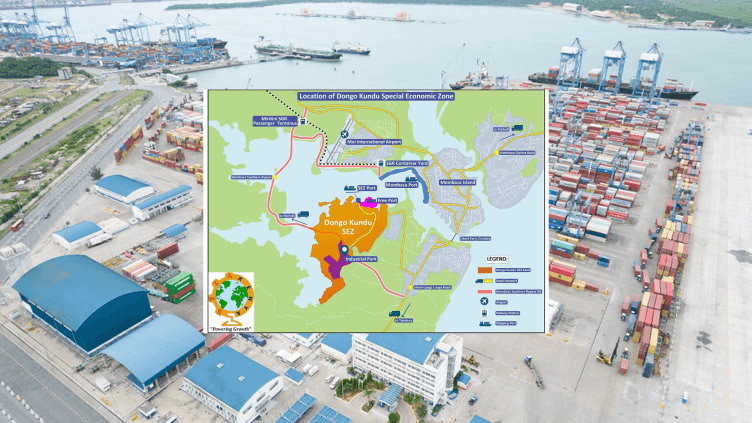
This is a public Special Economic Zone (SEZ) on the South Coast side of the Port of Mombasa. Some refer to it as Mombasa SEZ given that it the host location hence the 2 names used interchangeably.
Background:
The idea of a large-scale freeport / SEZ at Dongo Kundu is tied to Kenya’s Vision 2030 flagship projects and the national push to move from being a transit port to a regional manufacturing and logistics hub.
Early technical inputs and master-planning support came from development partners (notably Japan International Cooperation Agency(JICA), who helped draft schematic master plans and environmental/social assessments to guide land use, port berthing and the mix of industrial vs service areas.
The SEZ covers about 3,000 acres and located immediately adjacent to the Port of Mombasa, which gives it a strategic advantage for maritime cargo handling, trans-shipment and integrated logistics.
The land is largely state-owned and administered through agencies around the port estate, majorly the Kenya Ports Authority (KPA) who are also actively involved its development.
The site’s connectivity is reinforced by the new famous Mombasa Southern Bypass (Dongo Kundu bypass), the Standard Gauge Railway (SGR) corridors and proximity to Moi International Airport.
Operations:
Kenya Ports Authority (KPA) leads physical development on port-side land (berths, logistics interfaces), while Special Economic Zones Authority (SEZA) handles licensing/incentives and investor facilitation. Enterprises then operate inside designated plots/precincts, with customs posts and estate management integrated at zone level. All benefits as a SEZ still apply.
It was launched in October 2019 having being conceived in 2015. Kenyan government signed a Memorandum of Understanding (MoU) with Japan for its implementation in 2019. Funds to finance the project was to be granted by the Government of Japan counterpart with 85.92% as a loan and the rest as a grant. This was aligned to JICA’s blended financing model, aimed at ensuring infrastructure delivery while minimizing fiscal strain on Kenya.
The project was valued at ksh 42.5 billion and expected to create more than 60,000 jobs in Mombasa. First phase was to be completed in June 2022 but still work in progress. The loan disbursement and physical works lagged because the project’s sequencing depended on completion of enabling infrastructure;notably the Dongo Kundu Bypass Phase II & III and supporting port access works. COVID-19 disruptions in 2020–2021 also played part in the lag.
One of the key challenges over the years has been community resettlement and compensation delays (affecting access and social license to operate), and environmental constraints (mangrove / coastal ecosystems). The government and implementing agencies have publicly documented resettlement action plans (RAPs), compensation commitments and vocational training for PAPs; these social obligations became part of the SEZ’s daily stakeholder-management workload during construction and into operation.
Development Status:
A development lease agreement was signed in February 2025 between African Export-Import Bank (Afreximbank) and the Kenyan Government for a USD 1 billion program of investments and enabling infrastructure across this SEZ and Naivasha SEZ. Projected job creation of opportunities were cited at 40,000.
The zone is more of work in progress and the following core activities are expected at scale:
- Port-side works / berth planning – KPA has designed berths and port infrastructure specifically to serve the SEZ, and multi-purpose berth projects have been budgeted and tendered.
- Bulk 7 Energy Nodes – LPG/Fuel, grain terminals adjacent deep sea berths and storage farms.
- Logistics & warehousing hubs integrated with port berths.
- A freeport / free trade zone area for transshipment & re-export.
- An industrial park with plug-and-play factory plots and utility corridors.
In November 2024, Kenya Revenue Authority (KRA) formally designated Taifa Gas (SEZ) Ltd’s Dongo Kundu premises as a Customs Area, enabling duty-free operations under SEZ rules acknowledging shift from development to active operations with its first on-the-ground enterprise.
Conclusion:
Dongo Kundu SEZ, as a public zone, enjoys direct SEZA control, fast-track investor onboarding, and rare advantages like a gazetted customs area at Taifa Gas. Current coordination has moved it into operational rollout with the real test now being clustering anchor industries to lock in its place as the Coast’s flagship industrial maritime hub.
A key consideration for us when looking at investors is how many jobs you will create for the people. The people being beneficiaries is a priority.
For more information, reach out to us via info@rickfes.co.ke
At Rickfes Construction Ltd, we are keen to receive and facilitate investors; local or international; seeking to establish their developments into this SEZ. Our role is to be your development partner, liaison and local representative on the ground while in setting up in this SEZ.