
Inside Konza City SEZ
Konza Technopolis is the most popular public Special Economic Zone (SEZ) in Kenya and branded the famous title of Africa`s Silicon Savannah due to the big dream of transforming it to a tech hub. Manufacturing and Tertiary institutions majorly dominate and plans still underway to have residential developments to host at least 30,000 people.
Background:
- Konza Technopolis is the flagship smart‑city and innovation hub envisioned under Kenya’s Vision 2030 as a transformative high‑tech and science park, aiming to diversify the economy, drive digital transformation, and contribute at least USD 1.3 billion (about 2 % ) to national GDP by 2020. Hence, popularly tagged as Africa`s silicon savannah.
- Planning began around 2008, with feasibility studies by Deloitte and Pell Frischmann with financing from International Finance Corportation(IFC). The initial brief was for it to be a technology park of about 700 acres with It businesses at its core and the Frischman proposed it a more viable destination and a new master plan was unveiled for phase 1 in July 2012 by Master Delivery Partner 1 (MDP1). Hence the name Konza techno-polis. “Techno” to mean technology and “polis” which is greek to mean a city. The full development cost was projected at USD 14–15 billion for all five phases.
- The same study recommended the creation of a management board and that led to the formation of Konza Technolopolis Development Authority (KoTDA) in 2013. The groundbreaking was in the same year by the late president Mwai Kibaki and the ambition appeared to have died since then until the SEZ Act was created in 2015.
- In July 2019, Konza was formally gazetted as a Special Economic Zone (SEZ), with the Konza Technopolis Development Authority (KoTDA) granted both developer and operator licenses under the Special Economic Zones Authority (SEZA) framework.
- Konza covers 5,000 acres spreading within the counties of Machakos, Makueni, and Kajiado, within a special planning‑belt buffer zone jointly regulated with county governments. The land was acquired from Malili Ranch Limited for about Ksh 1 billion; a deal that caused subsequent legal disputes and controversy over due diligence.
Operations:
- KoTDA coordinates parcel allocation, infrastructure rollout, planning guidelines, business licensing, marketing to investors, and local community engagement. It manages central facilities like Data Centre, welcome/operations hub, transit hub, safety complex (police, fire), and utility tunnels.
- One major (unpopular) challenge that Konza faces is the location in reference to Kenya`s capital. Corporate tenants evaluate heavy relocation costs, risk‑averse firms and skepticism over whether soft infrastructure (talent, culture, research ecosystem) can keep pace with real estate delivery. This is still work in progress and they are also keen to tap into Makueni region.
- There were also funding delays and bureaucratic red tape during the roll out before the SEZ framework came in place.
Development Status:
Now extensively developed through Economic Innovation Partnership Programs (EIPP) with the Govt of Korea.
Phase 1:
- This phase was also expected to generate 16,000 direct jobs.
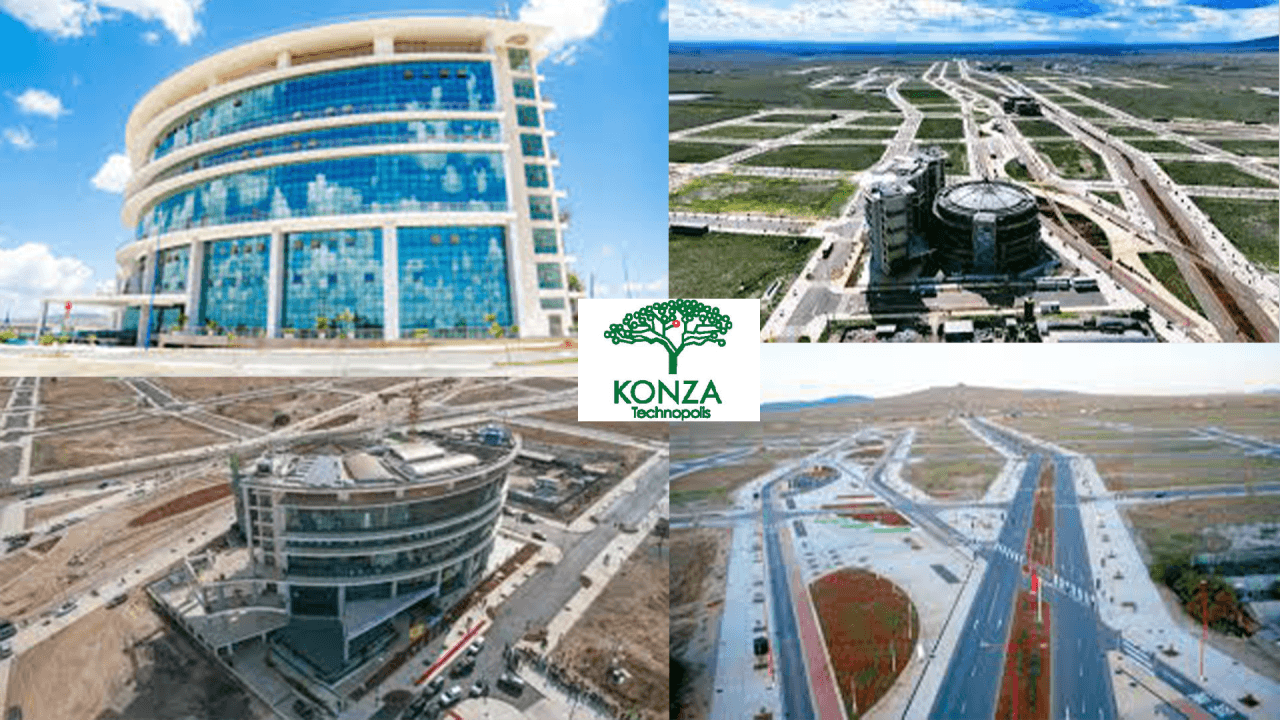
- Entails horizontal infrastructure and done in partnership with an Italian firm, supported by a USD 391 million Italian‑funded contract signed in 2017. This included 40 km of roads with storm‑water and sewage, power & telecom network, a water treatment plant/reservoir, public spaces, a welcome center, safety hub, utility tunnels, waste facility, and transit hub; all covering a total of 400 acres.
- The Konza complex office block was completed in 2019 and serves as the headquarters. The Open University of Kenya is hosted also there and the second phase will comprise a five star hotel and a conference facility.
- Both phases of the national data center completed by 2021 consisting of containerized units and smart city facilities, built using Chinese concessional loans.
- The Kenya Advanced Institute of Science and Technology (KAIST) is being built on a 36 acre piece of land at a cost of USD 10 million. The cabinet has already approved it as a specialized post degree awarding institution. First phase is done and the second phase consisting of labs and hiring faculty to be completed in 2026.
- Konza Technopolis Security Command Centre which constitutes a police station, fire station, emergency security unit and security barrier.
- A handful of early operational enterprises include device‑assembly factory East Africa Device Assembly Kenya Ltd was launched in October 2023.
- Discussions of also a having a drone‑assembly factory emerged mid‑2024; intended to produce low‑altitude commercial drones regionally, with projected job creation and knowledge transfer
Phase 2:
- Signed deal to Establishment of a digital media city on 65 acre land and financed by Govt of Korea meant to support Kenya`s content creators & digital innovators.
- The Korea Electronic Association to establish a USD 1.4 million electronics and information technology manufacturing support center to unfold in four phases over 2-3 years.
- By end of 2024,atleast 85% of the remaining parcels at Konza Technopolis had been committed by investors such as Riara University (construction ongoing), the Africa Center for Technology studies and The National Housing Corporation.
- On February 2025, the government gave an ultimatum urging investors to start developing their parcels of land in efforts to push for rapid development of the area.
Conclusion:
- Given that it is a public SEZ, it benefits from quicker SEZA interface for investor onboarding, pilot programs, and public sector incentives e.g OUK’s location via gazette
- There is also a risk in it remaining an infrastructure shell should bureaucratic delays and slow public sector decision making take over the moments as it heavily deters even the local investors.
- Under the current leadership, it picked up better pace, and now entering a stage where policy enactment (Konza Bill), investor readiness enforcement, and ecosystem deepening will determine whether the Silicon Savannah evolves into a sustainable innovation and investment center for the region.
Konza Technopolis is a hub where innovation meets opportunity, positioning Kenya at the forefront of Africa’s tech revolution.
For more information, reach out to us via info@rickfes.co.ke
At Rickfes Construction Ltd, we are keen to receive and facilitate investors; local or international; seeking to establish their developments into this SEZ. Our role is to be your development partner, liaison and local representative on the ground while in setting up in this SEZ.