
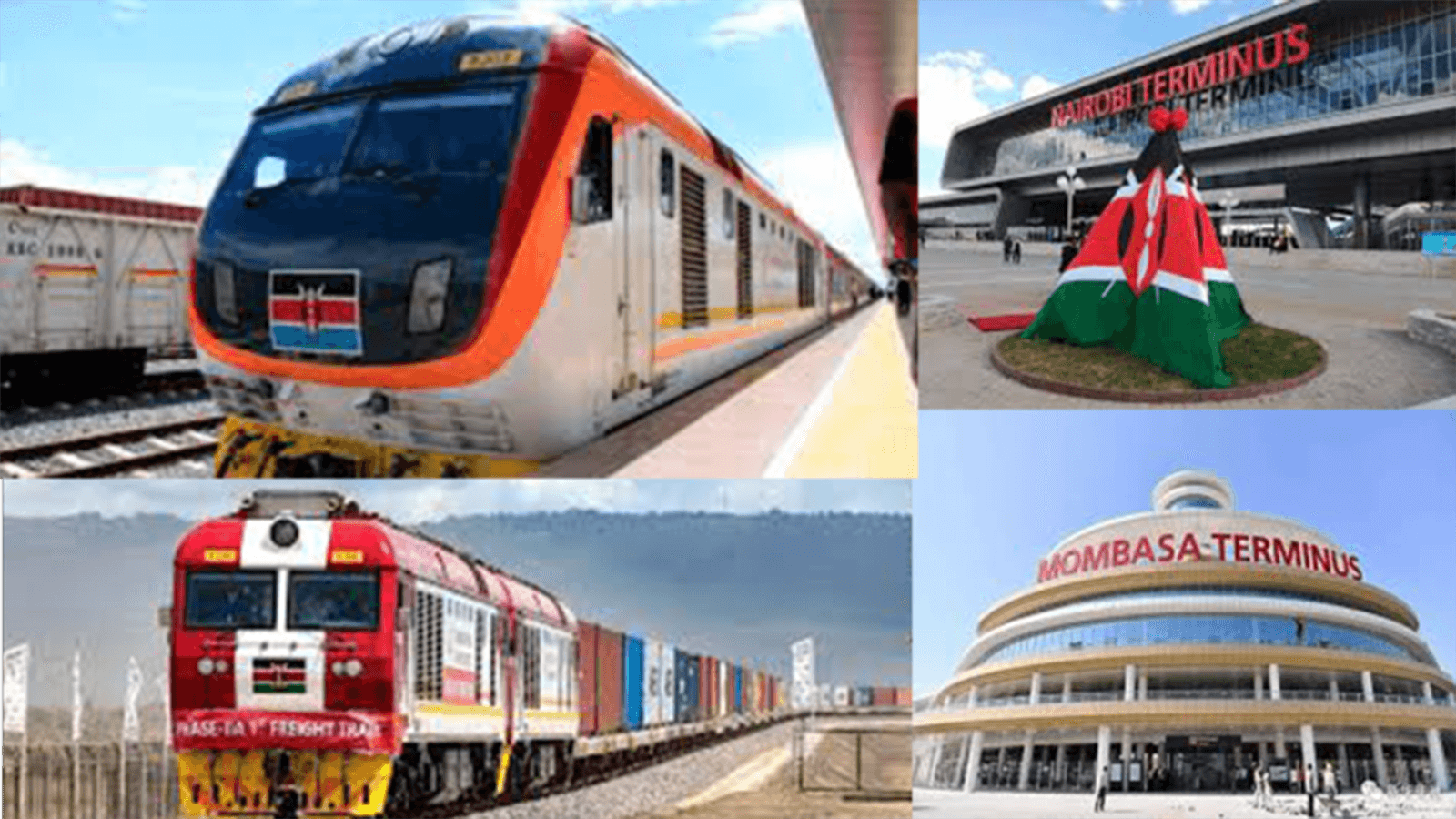
The Kenya Standard Gauge Railway (SGR)
The Standard Gauge Railway (SGR) as known to many is a landmark of the country`s infrastructure that was conceived in 2008. The Kenyan Government and the Ugandan Government first promoted the idea as part of a Northern Corridor Initiative to link the Kenyan coastal city of Mombasa to the landlocked countries of the Great Lakes Region.
The purpose of the project was to construct a railway from the Kenyan port of Mombasa to Nairobi (phase 1) to Naivasha (Phase 2A) to Kisumu (phase 2B) and then onward to Malaba (phase 2C).
The project sought to transport passengers and cargo from Nairobi to the southeastern port city of Mombasa at 120 kilometers per hour, thus reducing travel time between Nairobi and Mombasa from more than 10 hours to less than 6 hours and reducing transport costs by as much as 60% The Kenyan Government estimated that the railway would increase the country’s annual rate of economic growth by 1.5%. This was not a PPP but procured through public debt financing where the China Exim Bank loaned Kenya 90% of the money as the Kenyan Government floated the deficit.
Development History:
2009
In August, the Ministry of Transport (MoT) and China Road and Bridge Corporation (CRBC) signed a memorandum of understanding, whereby CRBC agreed to undertake a feasibility study of the SGR project at no cost.
2011
In January, CRBC submitted a feasibility report to the ministry, which concluded that Phase 1 of the railway’s expected economic internal rate of return (EIRR) was of 14.66%, which was higher than the Government of Kenya’s projection of 12%.
2012
- In June, Kenya Railway Corporation (KRC) approved a feasibility study and preliminary project design CRBC for Phase 1 of the SGR.
- In July, KRC and CRBC signed a commercial contract worth $2.66B referenced “Construction on the Civil Works of Mombasa-Nairobi Standard Gauge Railway Project EPC Turnkey Commercial Contract”.
- In October, KRC and CRBC signed another commercial contract worth $1.15B referenced “Supply and Installation of the Facilities, Locomotives and Rolling Stocks for the Mombasa-Nairobi Standard Gauge Railway Project Contract”.
- The project was then approved in August by the cabinet approved which was followed by the signing of a bilateral agreement by the Kenyan and Ugandan governments for the construction of the railway (that was later upgraded to a tripartite agreement with the Rwandan government) to extend to their regions.
2013
- In July, the Kenya National Treasury and China Exim bank signed an MOU that was witnessed by President Kenyatta based on the commercial (EPC) contracts that CRBC and KRC signed in 2012.
- An Environmental and Social Impact Assessment (ESIA) was also done in accordance with Exim Bank’s 2007 Guidelines on ESIA, 2015 Green Credit Guidelines and 2016 White Paper on green financing which requires that the project should not threaten the local environment or lack local environmental agencies approval.
2014
- In May, China Exim bank and the Kenya National Treasury signed two loan agreements worth $3.80B for Phase 1 of the SGR project . This was equal to 90% of the project cost.
- The first loan was a Buyer’s Credit Loan (BCL) worth $2.2B and it was provided on the following terms: a 5.25 year grace period, a 5 year (60 month) disbursement period, a 15.25 year maturity, an interest rate of 6-month Libor plus 3.6% margin, a 1% default (penalty) interest rate, a 0.75% commitment fee, a 0.75% management fee, a 6.93% insurance premium (payable in three installments) and a 1% default interest rate. The face value of the BCL was subsequently revised to $2B. The BCL was scheduled for 20 semi-annual repayments between July 2019 and July 2029.
- The second loan was a Preferential Buyer’s Credit (PBC) worth $1.6B and it was provided on the following terms: a 2 percent interest rate, a 0% default (penalty) interest rate, a 7.25 year grace period, a 7 year (84 month) availability period, a 20.25 year maturity, a 0.25% commitment fee and a 0.25% management fee. The PBC was scheduled for 26 semi-annual repayments between July 2021 and July 2034.
- The ultimate borrower (KRC) was expected to use the proceeds of the BCL and PBC to finance 90% of the total costs of the two commercial contracts that it signed with CRBC. The remaining 10% was to be paid by KRC to CRBC as counterpart financing.
- In order to facilitate repayment of its debts to China Exim bank, the Kenyan Government provided an assurance to the lender that it would guarantee a minimum amount of railway freight through the execution of a take-or-pay agreement between KRC and the Kenya Ports Authority (KPA). KPA also agreed to levy, a new 1.5% tax on imported goods (called the Railway Development Levy). This levy was designed to serve as insurance in case the revenues generated through the take-or-pay arrangement fall short of the amount required to service the China Exim bank loans. It was also to be used to finance the Kenyan government’s portion (15%) of the project (commercial contract) cost. KPA was answerable to KRC incase of revenue shortfalls in the event of inconsistency of cargo fleet.
- An escrow account was set up to hold funds for loan repayment. KRC was responsible of setting up and maintaining it and was cosigned by the Kenya National Treasury and China Exim bank. The account was to hold the following minimum amounts: $84M during grace period, $250M during repayment period and $80 post BCL full repayment. In the event KRC missed payments, the overdue amount is withdrawn along with 1% penalty and transferred to the China Exim bank and replenished from the revenue account. This was fully complied with during grace period and repayment period.
- In December, the project kicked off.
2017
- In May, the 475 km track length from Mombasa to Nairobi project reached completion and was 18 months ahead of schedule. A completion ceremony was quickly organized before the 2017 general elections.
- The first fare-paying passengers boarded the “Madaraka Express” on Madaraka Day (1 June 2017). Commercial freight services began on January 2018. There was a total of 9 passenger stations.
2018
In September, the Government sought another loan of about $3.36B from China to extend the line to Malaba and was turned down even after locking in the contractor. Chinese President Xi Jinping requested that approval be deferred until Kenya conducts a commercial viability study of the whole route (Mombasa to Kisumu). It is also reported that President Kenyatta requested China to give half of the loan needed for the project as a grant, as opposed to a loan, as a means to tame Kenya’s rising debt.
2019
- In August, phase 2A (120km) from Nairobi to Naivasha was completed at an extra cost of $1.5B. It begun in October 2016.
- The government directed that all containerized cargo at the Port of Mombasa be transported inland through the SGR. This move had a negative impact on the Kenyan coast’s port-based economy because it put many logistics companies out of business.
- This decision set off protests, riots and court cases. On December 2019 the senate committee on transport summoned the Cabinet Secretary for transport (CS Macharia) over his directive to haul cargo from the port city of Mombasa to Nairobi exclusively by rail. The meeting was attended by activists, businessmen and leaders from Mombasa. The CS promised to rescind the directive of which never happened.
2020
In September, lawmakers tabled a report in parliament recommending that the government renegotiate the terms of the China Exim bank loans for the SGR due to the prevailing economic distress occasioned by the effects of Covid 19. Amongst the proposals was to reduce operation costs by at least 50%. The SGR operators had to halt its passenger service for nearly three months due to concerns about the potential spread of the pandemic.
2022
- In March, KRC announced that it had begun the process of taking over the operations of the SGR from the Africa Star Railway Operation Company (ASROC or Afristar). By July 2024, they had assumed 47/52 operational functions and only left with signaling system management, dispatch coordination, freight management, and operations at Port Reitz and Nairobi Terminus. Afristar awarded a 10-year contract to operate and maintain the operations with an interim review planned after five years but negotiations were made to start takeover after 5 years instead. Full takeover expected by December 2025.
- In July, the Government received settlement notes (an overdue repayment notification) from China Exim bank and later in October it was reported that the Government defaulted on its China Exim bank loans for Phase 1 of the SGR project. The lender reportedly imposed a fine worth $10.8M.
- This was partly influenced by President`s Ruto directive to revert cargo clearing services from Nairobi inland container depot (ICD) to the Port of Mombasa. In November, the MoT under CS Murkomen finally disclosed all three China Exim bank loan agreements for the SGR project to the public and had clearly underperformed vis-à-vis the lender’s original expectations.
2023 – 2025
- In November 2023, KRC announce increase in fares effective January 2024 citing higher operation cost and high fuel cost. From Mombasa to Nairobi, to cost around $30 in first class, up from $19, and $10 in economy, up from $6.
- Conversations are still ongoing on the proposed extensions of phase 2B (262km) at $2.7B and phase 2C (107km) at $878M. Some preliminary works have began such as survey works and encroachment. Consultancy services have also been tendered for as of 2025.
- Additionally, the network has been expanded to cover about 2,750 kms. Mombasa extends to Lamu which extend to Isiolo then to Moyale. Another extension will be from Isiolo upwards to Nakodok and downwards back to Nairobi. It is all envisaged including the 2 phases to cost $15.3B and 85% financing to be done externally while the Government covers the deficit. Quite laughable given the period of completion is set to be on 2027 yet no budgetary allocations have been made. Ksh 100 billion was allocated in 2023 from the RDLF for the next 3 years to revamp the SGR line from Mombasa to Naivasha as well as buying more locomotives and cargo wagons.
- In January 2025, it was reported that the President Ruto is finalizing on a $1.5B commercial loan as a budget support for this endeavor.
Concerns:
1. Feasibility Study
- The feasibility study became a source of controversy. It had no cash flow projections. It asserted that the project would be highly profitable but its estimates of the net present value (NPV) of the project’s expected economic benefits varied between $2 billion and $2.6 billion. The report also recommended that the SGR be changed from an electric engine to a diesel engine.
- It was also inconsistent with the conclusions of previous studies undertaken by the World Bank and a Canadian consultancy firm(Canadian Pacific Consulting Services) but the Government only allowed CRBC to conduct the study. Additionally, a private business man by the name Jimmy Wanjigi had also submitted a feasibility study that stated the project is doable at a cost of $650M from Mombasa to Malaba but shelved under unclear circumstances.
- In essence, there was no competitive bidding and the court at the time refused to flag it. The Exim bank`s recommendation was also that any chinese firm that conducts the feasibility proceeds to implement a project .The tenders were also awarded without competitive bidding and 2 parliamentary committees called for cancellation which President Kenyatta refused. Later in 2020, the court of appeal declared that the SGR contract was illegal and should be made public of which the MoT still declined.
2. Financing & Profitability
- In 2018, a letter from Kenya’s Auditor General to the KPA was leaked suggesting that the Port of Mombasa’s assets were sources of collateral that could be seized in the event that the Kenyan government could not repay its loans to China Exim bank. It also added that the Kenyan government had waived its sovereign immunity rights in order to make this pledge of collateral.
- It was originally projected that the SGR would move 22 million tons of cargo a year. However, another assessment later revealed that the maximum amount of cargo that the railway could move was approximately 8.7 million tons of cargo a year. Remember that KPA was responsible to provide guarantee of the cargo fleet and in the event of shortfall top up the difference.
- CRBC operates the railway’s passenger and cargo service through its subsidiary, Afristar. The operation expenditure has always exceeded revenue, and the Kenyan taxpayer money has to fill the gap to sustain the company’s operations. In the first year it made a loss of $90.8M and a collective loss of $200M in the first 3 years.
- From the document released by the current Government in 2022, it appears the previous one overpaid for the project by 1200%. The 10% equivalent payable by the Kenyan Government was to be about $500M but was was paid was about $6.5B. This meant that the Exim bank loan was not needed at all and the money looks enough to have done it all the way to Malaba. This still remains unclear as the Government has never clarified anything about the transaction.
3. Implementation
- In September 2016, activisits led by Okiya Omtatah filed a petition at the National Environment Tribunal alleging that the SGR traversed Nairobi National Park which is protected area. The tribunal issued an injunction stopping the work until the case was heard. CRBC explored more than ten routes and selected one that bypassed the park but still adversely affected animal migration patterns.
- The project also became a target of an anti-corruption drive by Kenya’s Department of Public Prosecutions (DPP) made arrests of 18 individuals among them the chairman of National Land Commission (NLC), and managing director of the KRC on allegations that they had siphoned taxpayer money through fraudulent compensation claims for land used for the railway project.
- The Kenyan Government was also under pressure to release the documents but they declined on grounds that they had non-disclosure clauses and releasing them would breach breaching the bilateral agreement and undermine national security.
My conclusions:
- For what its worth, it cleared the port congestion significantly and was a reliable means of transportation through the mainland. It was also affordable for passengers and cargo transporters and costs reduced by up to 40%. Additionally, the fact that it reduced the risk of accidents was also a bonus for the society. Opportunities created were also significant and benefitted the locals.
- On the flip side, the the directive that all cargo goes through the SGR was draconian as it put many logistics firms out of business. Maybe they would have put a caveat, say category of good or tonnage e.t.c .Additionally, in as much as it spurred development, some towns collapsed or businesses for the towns that survived to to mentioned the unplanned resettlements even though there was fare compensation.
This project is a game changer and paves way for massive industrialization. Connectivity is a necessity for a progressive economy.
For more information, reach out to us via info@rickfes.co.ke
At Rickfes Construction Ltd, we are keen to conduct thorough research and critique on large infrastructure projects in the country as part of efforts to contribute to a better Kenya!