
Understanding Special Economic Zones in Kenya
Did you know that in just a decade, Kenya has quietly built one of Africa’s most investor-friendly economic models; backed by law, powered by policy and designed for global business? Behind the scenes, a new kind of economic zone is reshaping how industries operate, how investments are structured and how local and international players interact with Kenya’s economy; the Special Economic Zones.
As per the Special Economic Zone (SEZ) Act of 2015, this is a a designated geographical area where business enabling policies, integrated land uses and sector-appropriate on-site and off-site infrastructure and utilities are provided, or which has the potential to be developed, whether on a public, private or public-private partnership basis, with a view to facilitating the ease of doing business to promote and attract local and foreign investment.
Such designation and facilitation of development is done by Special Economic Zones Authority (SEZA) who is the regulator for all SEZs, both public and private. It works to attract, facilitate, license, and retain local and foreign direct investors in SEZs.
Special Economic Zones (SEZs) in Kenya were introduced as a policy and legal response to address limitations of Export Processing Zones (EPZs) and to stimulate industrialization, attract investment, and create jobs in a more inclusive and expansive way as part of Kenya Vison 2030.
SEZs were identified as a flagship project under the Kenya Industrial Transformation Programme (KITP) launched in 2015 by the Ministry of Industrialization. The Act was passed in 2015 and in 2017, SEZA began licensing private developers and enterprises which significant progress seen in 2019 with Tatu city and Konza city operationalized.
The facilitations by SEZA promotes ease of doing business and include:
- Single operating license – Combines all regulatory approvals into one license.
- Exemptions from various regulations and fees – Reduces red tape and operational costs.
- Quick project approval – Fast-tracks regulatory review and approvals.
- No exchange control – Allows free movement of capital and profits.
- Onsite customs support – Simplifies import/export processing directly within SEZs.
- Ensure unrestricted foreign investment – No limitations on foreign equity ownership.
- Process work permits for employees – Assists with immigration and work permit acquisition for expatriate employees.
On licenses, there are 3 types:
- Developer – This license is issued to a corporate entity engaged in the development of integrated infrastructure facilities on a designated SEZ.
- Operator – This license is issued to a corporate entity engaged in the management of a SEZ.
- Enterprise – This License is issued to a corporate entity carrying out a business in a SEZ.
Procedure for obtaining a license:
- Present a developer/operator project request letter to SEZA.
- Fill and Submit in SEZA Developer/Operator application form and attached relevant supporting documents as listed on the developer/operator application form
- SEZA assess and review the application
- Approval in principal will be issued with conditions to be fulfilled including incorporation of a SEZ company
- SEZA will issue SEZ Developer/Operator License to the investor upon payment of requisit fees and meeting the previous condition.
SEZs may be designated as either a single sector or multiple sector zones, public or private. Common sectors include:
- Industrial Parks – Allow for integrated infrastructure to facilitate manufacturing and processing industries.
- Free Trade Zone – Allow for trans-shipment, storage, bulk breaking, repacking, sorting, mixing, trading excluding manufacturing and processing.
- Science and Technology Parks – Established to facilitate science, technology and innovation.
- Free Port Zone – Goods introduced, are primarily for transshipment, re export or destined for other SEZs.
- Agriculture Zone – SEZ to facilitate agricultural sector and related activities and services.
- Business Service Parks – Facilitate provision of services , which may include ; to regional headquarters, BPOs, call centres, management consulting , advisory services and other associated services.
- Tourism and Recreation – Provide facilities and services for tourism and recreation attraction.
- Livestock Zone – Facilitate livestock marshalling and inspection, livestock feeding or fattening , abattoir and refrigeration , deboning, value addition, manufacture of veterinary products and other related activities are carried out.
- Information Communication Technology Park – SEZ established to facilitate science, technology and innovation.
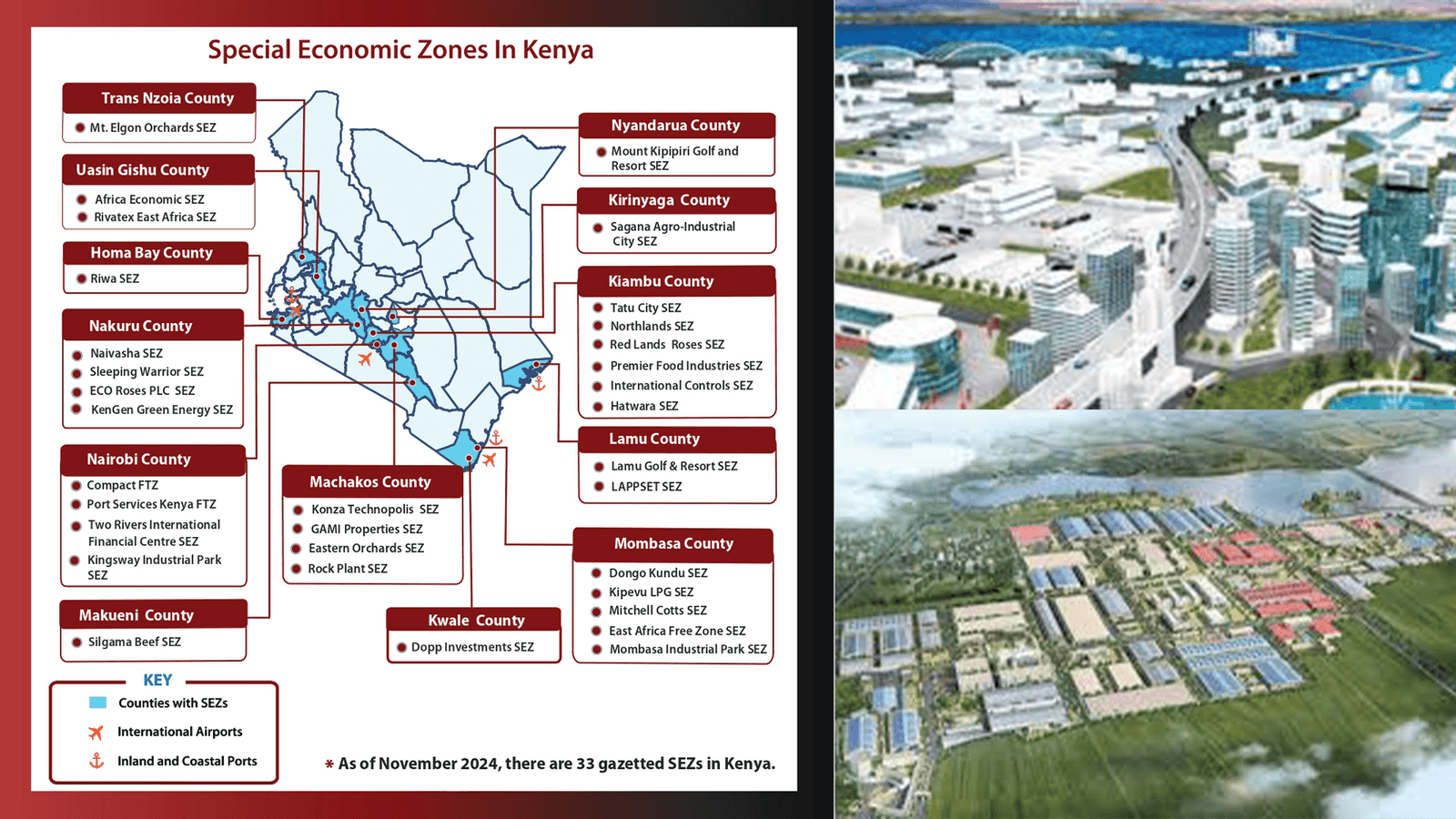
As of November 2024, there are a total of 33 gazetted SEZs in Kenya. 24 are private while 9 are public.
The following Fiscal Incentives promote competitiveness of SEZs:
- Imported goods are exempted from excise duty, import duty and import declaration fee
- VAT is zero rated. No value-added tax on taxable supplies.
- Preferential rates for corporate tax. 10% for first 10 years,15% for the next 10 years and 30% afterwards –
- Stamp duty is exempt on legal instruments executed in SEZ transactions.
- 100% investment deduction allowance on capital expenditure, building and machinery.
- Local Govt fees such as advertisement and business permit are exempt.
- For the first 10 years of operation, an SEZ developer, operator or enterprise enjoys reduced withholding tax on payments made to non-residents for: Royalties, interest, management fees, professional, training, consultancy, agency or contractual fees.
- Enjoys power supply for renewable sources of energy thus lower production costs. Ksh 5 per kwh in Naivasha SEZ,Ksh 10 per kwh in other SEZs and offpeak hours discounted to Ksh 7.62 per kwh.
It has been 10 years now. What is the score?
Kenya is beginning to reap the benefits of this strategic framework. Tatu City, Kenya’s first private SEZ, now hosts over 75 companies, schools, housing, and infrastructure; all functioning within a thriving ecosystem. Konza Technopolis, while still developing, already boasts a national data center, digital media city, and university hub attracting global partnerships.
SEZs have become powerful tools for job creation, industrial growth, and market access. They have opened up Kenya to international investment, boosted regional trade, and encouraged local manufacturing and tech innovation.
The SEZs exist so as to attract investors to expand their markets and create jobs for Kenyans.
For more information, reach out to us via info@rickfes.co.ke
At Rickfes Construction Ltd, we are keen to receive and facilitate investors—local or international—seeking to expand into these zones.