

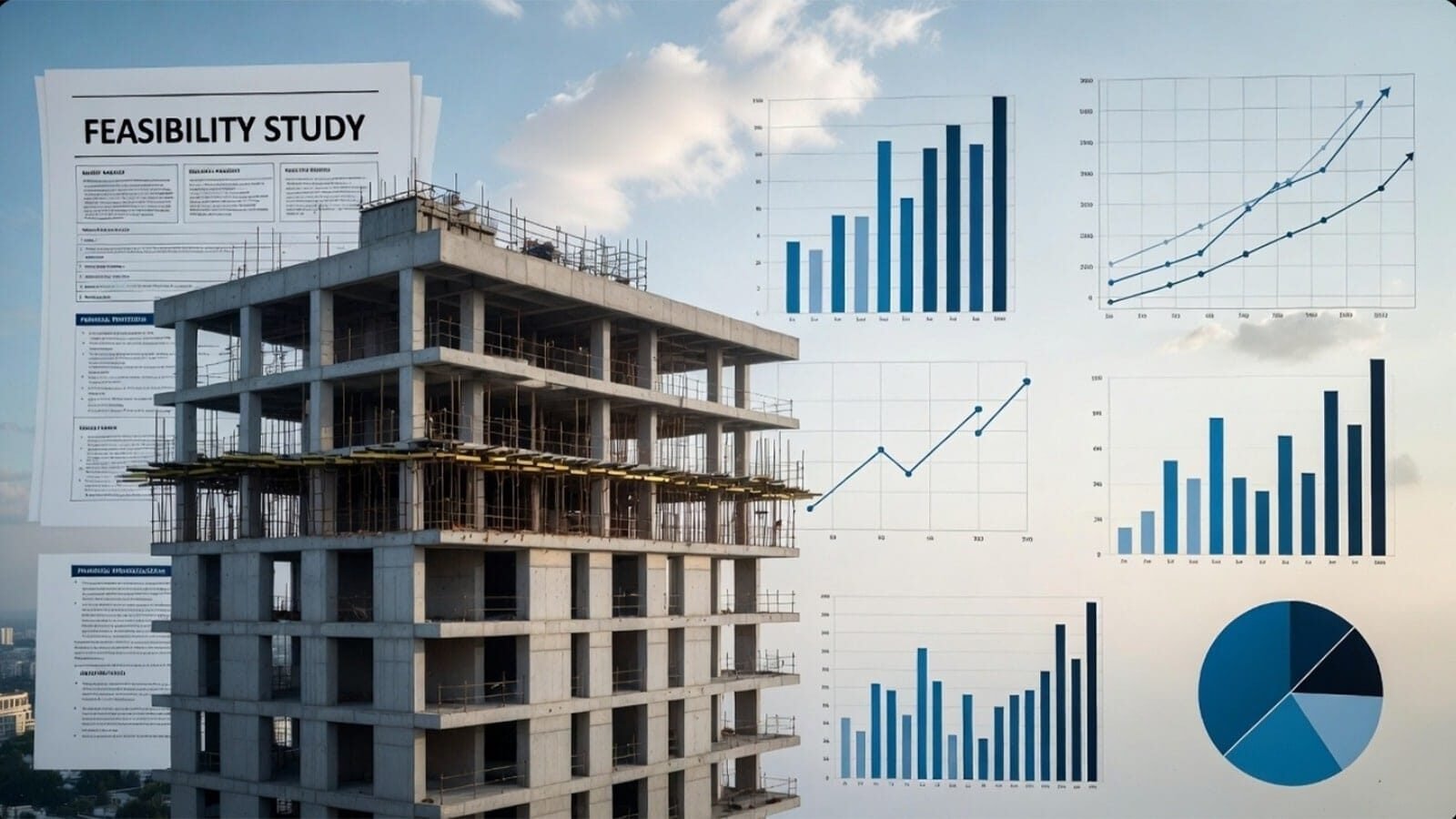
Why You Need That Feasibility Study Before Developing
In many urban and peri-urban neighborhoods today, apartment development has become a game of imitation. A developer looks around, sees that two-bedroom units are common and mostly occupied then concludes that this is what works. The next step is to design and build the same typology, targeting the same market.
This approach appears logical and the units may indeed be occupied. However, a critical mistake is confusing visibility with viability. What is visible is demand; what is invisible is profitability and this can only be determined through a feasibility study.
A building can be fully occupied and still fail financially. Rental levels, as dictated by the market, may be too low relative to construction costs, while operating expenses may be underestimated. A feasibility study compares these variables and evaluates profitability and the time required to recover the investment.
Unless the development has sentimental value, the result may be a fully occupied building that does not meet financial expectations.
This analysis shifts thinking from “what are others building?” to “what configuration produces the best financial outcome?”
Another common mistake is focusing only on total project cost while ignoring the structure of financing. A project funded entirely from savings does not carry the same risk as one financed through a combination of equity and debt. The feasibility study evaluates financing by analyzing:
- Debt servicing capacity from rental income.
- The impact of vacancies on loan repayment.
- Sensitivity to interest rate changes.
This analysis inspires strategic design rather than cosmetic design.
It informs decisions such as which unit sizes to build, whether to develop mixed-use or mixed-unit projects, whether to construct in phases or at once, and whether the land value justifies the scale of development.
This separation between desire and data is what distinguishes investment from speculation.
In conclusion, a feasibility study is not about proving that an idea will work but rather determining what will work.
A critical mistake is confusing visibility with viability. What is visible is demand; what is invisible is profitability and this can only be determined through a feasibility study
For more information, reach out to us via info@rickfes.co.ke
At Rickfes Construction Ltd, we prepare feasibility studies that guide unit mix, project scale, financing structure, and phasing strategies. Our role is to help property owners and developers make informed decisions that convert land into financially viable real estate projects built on verifiable data rather than assumptions.